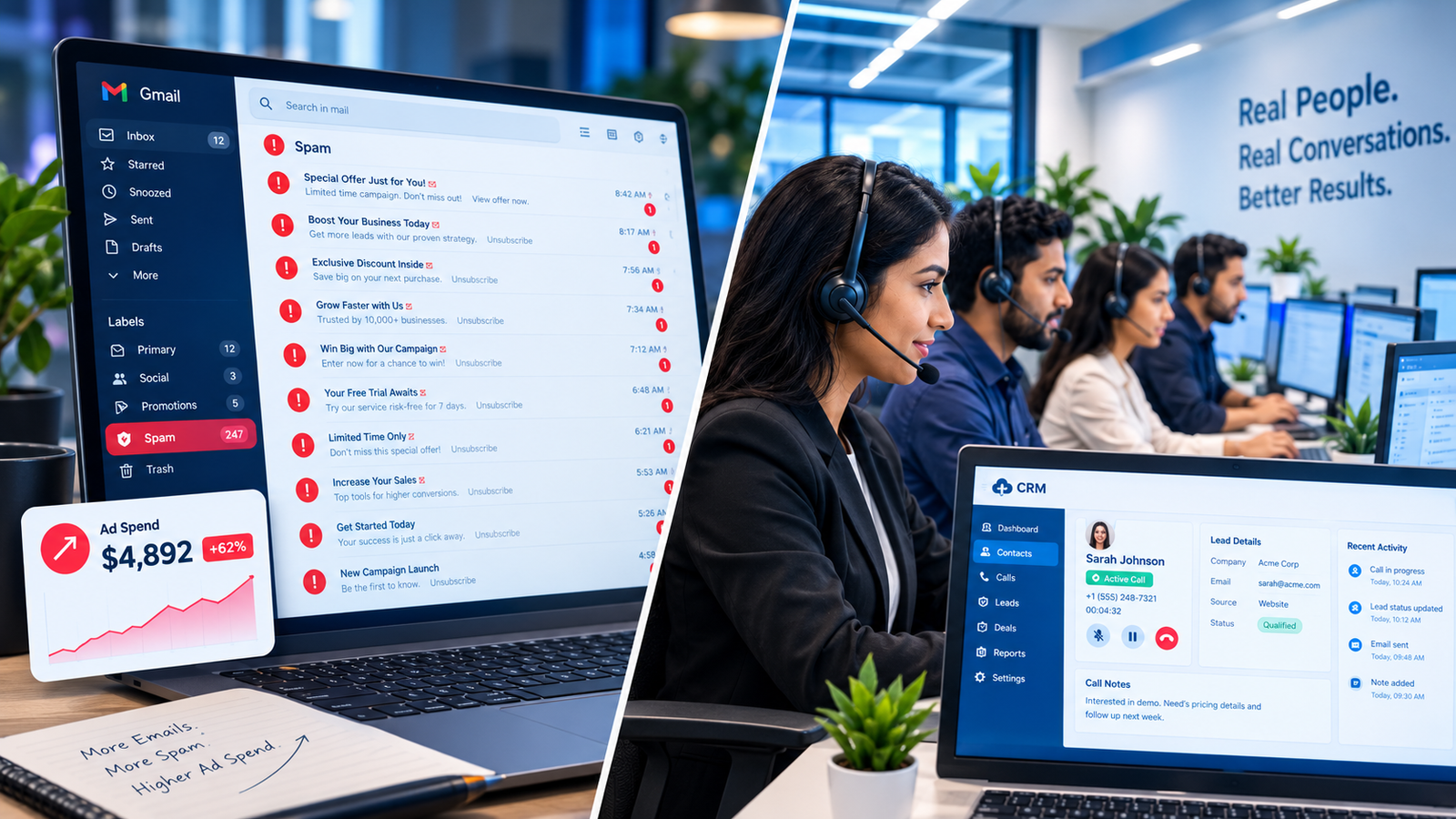
Getting qualified prospects in front of your sales team has become harder and more expensive on almost every channel except one. Here is what changed in 2026, why a live conversation still works, and how a mortgage company used an outsourced calling team to build a pipeline that kept its sales team busy for the next six months.
Published by Synthesis BPO · Reviewed by Vinesh Nair, Co-Founder, VisionSync Solutions · October 26, 2026 · 9-minute read
Key facts
- Email is harder to land. Inbox providers are tightening the rules for marketing email. Since November 2025, Gmail has been ramping up enforcement against senders that fail authentication, unsubscribe, or spam-complaint requirements, and rejected or spam-foldered mail is the result.
- Paid ads are expensive. In WordStream’s 2026 benchmark of U.S. Google search campaigns, the average click cost $5.42 and the average lead cost 66.69(74.44 in finance and insurance). Meta lead campaigns averaged $27.66 per lead in 2025, up 21% in a year.
- A form fill is not a conversation. An ad lead is a name and a number. Nobody has spoken to them, qualified them, or heard what they actually need.
- Phone is still the dependable channel. A caller reaches a person during business hours, explains briefly what you offer, and finds out on the spot whether there is a fit.
- How we scale: start with one or two callers, prove the return, then grow the team to what your sales team can actually work.
- Case study: Gen Next Mortgage built a qualified pipeline in about five months that kept its sales team busy for the following six months.
- Typical rate: $8 to $12 per person per hour, agreed in writing before the program starts. We do not guarantee a set number of leads or sales.
What has changed about lead generation in 2026?
Three of the channels most businesses rely on have become harder or more expensive to use, while the oldest one has held up. Here is how they compare:
| Email campaigns | Paid ads (Google, Meta) | Phone-based lead generation | |
| What gets in the way | Spam filters, company email security, and stricter sender rules | Rising auction prices, and ad budgets that never stop | Call screening, and the need for a good list and trained callers |
| What you get | An open or a click, if the message arrives at all | A form fill from someone nobody has spoken to | A live conversation and an answer on the spot |
| Cost shape | Low per message, but delivery is uncertain | A monthly budget, often thousands of dollars | Per person per hour, with a team you can scale up and down |
| Qualification | After the lead replies, if it does | After the lead arrives, by your own team | During the call, by the caller |
This is a summary of common patterns, not a verdict on every business. Plenty of companies still make email and ads work. The point is how much they cost, how reliably they deliver, and how many conversations they actually start.
Why do marketing emails reach fewer people?
Because inbox providers and company security filters now stand between your message and the person you wrote it for. Email has more filtering and more rules than it did a few years ago, and unsolicited marketing is the kind of mail those filters are built to catch.
Gmail is a good example. Its bulk-sender requirements ask senders of 5,000 or more messages a day to authenticate their mail (SPF, DKIM, and DMARC), include one-click unsubscribe, and keep user-reported spam complaints below 0.1%, never reaching 0.3%. According to Red Sift’s November 2025 summary, Gmail began ramping up enforcement in November 2025, and non-compliant mail can be rate-limited, rejected, or sent to spam.
Those rules are aimed at bulk senders, and a small business running a prospecting campaign may not qualify as one. But they show the direction: unsolicited commercial email has to clear authentication, filters, spam folders, and company security gateways before a person ever sees it. In our experience, that means a prospecting campaign can be sent and still not be read.
Why are paid ads so expensive to run for leads?
Because you are bidding against every other business that wants the same prospect, and the price of that competition keeps rising. Two benchmarks show the scale:
- Google search: WordStream’s 2026 benchmark (13,474 U.S. search campaigns, April 2025 to March 2026) puts the average cost per click at $5.42 and the average cost per lead at $66.69. In finance and insurance, the average cost per lead was $74.44. The cost per lead slipped slightly from $70.11 the year before, its first drop since 2020, but the cost per click kept climbing.
- Meta (Facebook and Instagram): WordStream’s 2025 benchmark put the average cost per lead for lead campaigns at $27.66, up 21% year over year. That is cheaper per lead than Google, but notice what is being counted: a person who filled in a form.
Here is a rough illustration, not a promise of results. One dedicated caller working a full month, at about 170 hours and $10 an hour, comes to roughly $1,700. Spent on Google search ads at the average cost per lead, the same $1,700 buys about 25 form fills. Spent on Meta at its average, about 60. Those are people who clicked, not people who were called, qualified, and told what you can do for them. A caller’s month produces conversations, and what comes of them depends on your offer, your list, and your sales team.
For many businesses, the harder problem is budget. Not every company can spend thousands of dollars every month on advertising and still have to qualify what comes back.
Why does phone-based lead generation still work?
Because a live call does something email and ads cannot: it reaches a person, gets a direct answer, and starts a conversation that can be steered. You call during business hours, give a brief explanation of what you can do for them, and listen. People are usually open to hearing how a business can help them grow, because growth is on most owners’ minds.
Phone has its own friction. Some people screen calls, and calling rules apply, including the National Do Not Call Registry. That is why list quality, calling windows, and trained callers matter more on the phone than they might elsewhere. Done properly, though, it remains the most direct way to qualify a prospect, and it does not depend on a filter, an auction, or an algorithm.
It also fits the way many businesses want to buy: not a bigger ad budget, but a team that does the heavy lifting of calling and qualifying, so their own people can focus on closing.
How does outsourced lead generation help a business scale?
By letting you add calling capacity in steps instead of hiring a department up front. In practice, scaling with us looks like this:
- Start small. Most engagements begin with one or two callers. That is enough to set the right practices without committing before you have seen results.
- Train the first batch. You, or an experienced member of your team, train the initial callers, usually over a day or two, and stay available for questions in the first week or two. Our trainers sit in and document the process, so adding callers or replacing one later does not mean reteaching everything.
- Supervise and report. A dedicated supervisor coordinates between your team and the callers. A dedicated quality analyst reviews call recordings. You get CRM access, regular updates, and standing calls.
- Prove the return. Once the performance and the quality of the leads are clear, you decide how far to grow.
- Scale to what your sales team can work. We grow the team based on how many qualified prospects your own people can actually follow up, not on call volume for its own sake. If your needs drop, the team can come back down.
Case study: how Gen Next Mortgage built a six-month pipeline in five months
Gen Next Mortgage, a mortgage refinancing company, came to us for its first outsourcing engagement. Its goal was a pipeline of qualified refinancing prospects for its sales team.
The list was not cold. Everyone on it had already engaged with Gen Next Mortgage in some way: through flyers, filled-in forms, or the summits and seminars the company runs. They knew who was calling and roughly why, which made the conversations different from cold calling.
We started with one caller, scaled to two as the campaign ramped, and brought it back to one as the pipeline filled. The engagement ran about five months. In that time the team built a qualified pool of prospects large enough to keep Gen Next Mortgage’s sales team working for the next six months. At that point the client paused the engagement to work through the pipeline, and plans to resume when it has a new batch of leads to call. The program was custom-quoted at $10 an hour.
We are not claiming loans closed or revenue earned for this account, because those depend on the client’s own sales process. What the engagement shows is how the model works: a small team, a warm list, a pipeline big enough to occupy the client’s sales team, and the flexibility to scale up, step back down, pause, and restart.
Case study: from two callers to ten
A New York-based mortgage refinancing company, which we are keeping anonymous at the client’s request, came to us to profile and qualify refinancing prospects. It had its own acquired leads and an existing customer database. We started with a two-caller pilot focused only on profiling and qualification.
The results were strong enough that the client scaled the team to ten callers. The engagement has now run for more than eleven months. It has grown from profiling into a full profiling-and-sales calling program, with recurring mid-term campaigns that re-approach prospects who did not qualify the first time, when their circumstances may have changed. It is supported by the same structure we use from day one on any account: a dedicated supervisor and a dedicated quality analyst.
We have not been given permission to share a measured result for this client, so we are not publishing one.
What should you expect, and how long does it take?
Expect a learning period first. The first one to two weeks are for training the callers on your business, offer, and process, and they need your active involvement. After that, the team needs time to find its rhythm before a workable pipeline forms. Gen Next Mortgage’s six-month pipeline took about five months to build.
Most clients plan around this. The ones who struggle are those who expect results in the first few weeks. The model is rarely broken in those cases; the timeline was set incorrectly at the start. We would rather agree month-one, month-two, and month-three expectations with you at the outset.
What about compliance on outbound calls?
You supply the prospect list, scrubbed against the Do Not Call registry, and we call from it. If a contact says they are on a Do Not Call list or asks not to be called again, our agents apologize, remove them, tell you, and make sure they are not called again. A dedicated quality analyst reviews call recordings for compliance, backed by AI-assisted tooling that supports that human review rather than replacing it. Calling rules vary by state and by campaign, so check your own obligations with your legal or compliance adviser.
How to evaluate an outsourced lead generation partner
Ask every provider these questions, including us:
- Who exactly will be calling? What experience do they have, and can you interview them before they start?
- Where do they work? In an office or from home, and in which country?
- Who supervises them, and who reviews the calls? How often will you hear from them?
- What do you need to provide? The list, the offer, the training, and your involvement in the first weeks.
- How is a lead defined? What must be confirmed before a prospect counts as qualified?
- What happens if a caller is not performing? How quickly can they be replaced?
- How does the team scale up and down? And what does it cost to change?
- How is pricing structured? Is it per person per hour, and what is included?
- What do they refuse to promise? Be wary of anyone guaranteeing a set number of leads or sales.
What does outsourced lead generation cost?
Our lead generation services run $8 to $12 per person per hour, depending on the requirement, the experience the account needs, and the scope. The rate is agreed in writing before the program starts, and we do not add line items later. Gen Next Mortgage, for example, was custom-quoted at $10 an hour. See our Services & Pricing guide for the full picture.
Why Synthesis BPO and VisionSync Solutions
Synthesis BPO is a sister concern of U.S.-registered VisionSync Solutions LLC, our parent company. Our founders spent more than fifteen years in this industry, working with 400+ clients, before starting Synthesis BPO, and we run every engagement on the same principles:
- An extended team, not a vendor that takes a task and disappears. We learn why you are outsourcing, how you want the work done, and where your boundaries are.
- Experienced callers. We generally look for at least two years of relevant experience, and you can interview candidates before they start.
- Our own offices, no work from home. All of our staff work from our dedicated offices in India and the Philippines, under the supervision of team leaders, managers, and trainers.
- A fast fix if it isn’t working. If you decide a caller is not the right fit, we look at whether there is room to improve. If we agree there is not, we replace them, typically within one to two weeks and sometimes within days.
- Clear, per-person pricing. No surprise line items.
To talk through your requirement, call +1 (800) 427-4470 or email info@synthesisbpo.com
Frequently asked questions
What is outsourced lead generation? Outsourced lead generation means a service provider’s team contacts and qualifies prospects on your behalf, and passes the suitable ones to your sales team. At Synthesis BPO, that is mainly done by phone, working from a list and qualification criteria you provide.
Is cold calling still effective in 2026? In our experience, yes. Email is increasingly filtered and paid ads cost more, while a call reaches a person and starts a conversation. Results depend on the list, the offer, the callers’ training, and your sales follow-up, and warm lists such as people who have attended your events or filled in your forms usually go better than cold ones.
Why not just run email campaigns or paid ads? Many businesses do, and they can work. The difficulty is that email faces filtering and sender rules, and ads carry a rising cost for each lead, which is a form fill rather than a qualified conversation. Phone outreach is a complement that puts a person in the conversation. Some clients keep all three running.
How much does outsourced lead generation cost? $8 to $12 per person per hour, agreed in writing before the program starts. Our Gen Next Mortgage engagement was quoted at $10 an hour. That is a staffing rate, not a cost per lead, and we do not guarantee a specific number of leads.
How many callers do I need to start? Most engagements begin with one or two callers. Gen Next Mortgage started with one, and the New York mortgage refinancing client started with two before growing to ten.
How long before I see results? Plan for a learning period of one to two weeks, then a ramp-up before a workable pipeline forms. For Gen Next Mortgage, the pipeline took about five months to build.
Do you guarantee a number of leads or sales? No. Outcomes depend on your offer, your list, your qualification rules, and your sales follow-up. Any service levels have to be agreed in the engagement documents.
Who provides the prospect list? You do. We ask for a list scrubbed against the Do Not Call registry, along with your offer, qualification criteria, and training.
Where are your callers located? In our own offices in India and the Philippines. Nobody works from home.
What if a caller isn’t performing? Tell us. We look at whether there is room to improve, and if we agree the person is not the right fit, we replace them, typically within one to two weeks and sometimes within days.
Can I scale the team up and down? Yes. Gen Next Mortgage ran with one caller, then two, then back to one as the pipeline filled, and later paused. The New York client grew from two callers to ten.