Email Is Filtered, Ads Are Expensive: How Outsourced Lead Generation Scales a Business in 2026
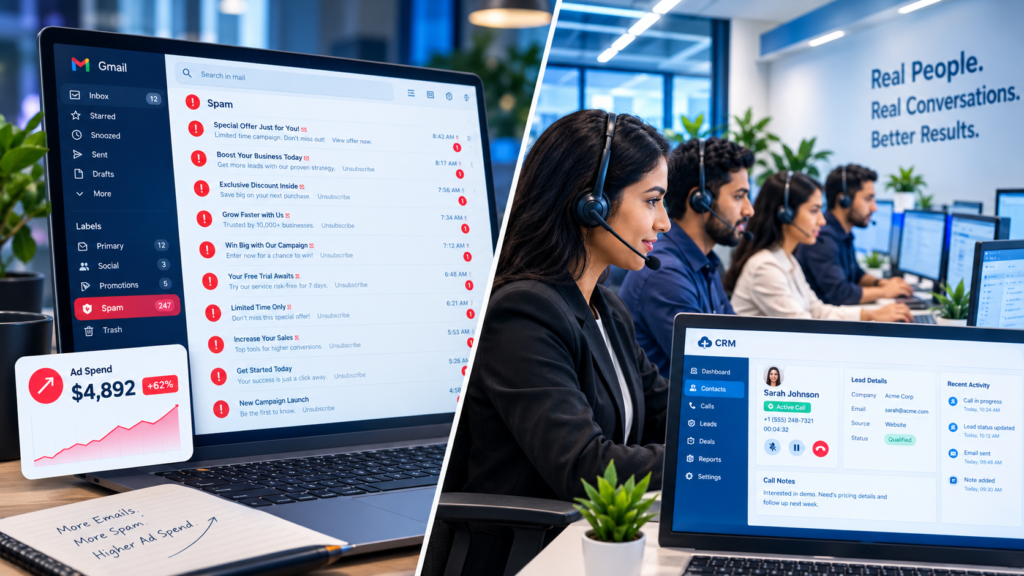
Getting qualified prospects in front of your sales team has become harder and more expensive on almost every channel except one. Here is what changed in 2026, why a live conversation still works, and how a mortgage company used an outsourced calling team to build a pipeline that kept its sales team busy for the next six months. Published by Synthesis BPO · Reviewed by Vinesh Nair, Co-Founder, VisionSync Solutions · October 26, 2026 · 9-minute read Key facts What has changed about lead generation in 2026? Three of the channels most businesses rely on have become harder or more expensive to use, while the oldest one has held up. Here is how they compare: Email campaigns Paid ads (Google, Meta) Phone-based lead generation What gets in the way Spam filters, company email security, and stricter sender rules Rising auction prices, and ad budgets that never stop Call screening, and the need for a good list and trained callers What you get An open or a click, if the message arrives at all A form fill from someone nobody has spoken to A live conversation and an answer on the spot Cost shape Low per message, but delivery is uncertain A monthly budget, often thousands of dollars Per person per hour, with a team you can scale up and down Qualification After the lead replies, if it does After the lead arrives, by your own team During the call, by the caller This is a summary of common patterns, not a verdict on every business. Plenty of companies still make email and ads work. The point is how much they cost, how reliably they deliver, and how many conversations they actually start. Why do marketing emails reach fewer people? Because inbox providers and company security filters now stand between your message and the person you wrote it for. Email has more filtering and more rules than it did a few years ago, and unsolicited marketing is the kind of mail those filters are built to catch. Gmail is a good example. Its bulk-sender requirements ask senders of 5,000 or more messages a day to authenticate their mail (SPF, DKIM, and DMARC), include one-click unsubscribe, and keep user-reported spam complaints below 0.1%, never reaching 0.3%. According to Red Sift’s November 2025 summary, Gmail began ramping up enforcement in November 2025, and non-compliant mail can be rate-limited, rejected, or sent to spam. Those rules are aimed at bulk senders, and a small business running a prospecting campaign may not qualify as one. But they show the direction: unsolicited commercial email has to clear authentication, filters, spam folders, and company security gateways before a person ever sees it. In our experience, that means a prospecting campaign can be sent and still not be read. Why are paid ads so expensive to run for leads? Because you are bidding against every other business that wants the same prospect, and the price of that competition keeps rising. Two benchmarks show the scale: Here is a rough illustration, not a promise of results. One dedicated caller working a full month, at about 170 hours and $10 an hour, comes to roughly $1,700. Spent on Google search ads at the average cost per lead, the same $1,700 buys about 25 form fills. Spent on Meta at its average, about 60. Those are people who clicked, not people who were called, qualified, and told what you can do for them. A caller’s month produces conversations, and what comes of them depends on your offer, your list, and your sales team. For many businesses, the harder problem is budget. Not every company can spend thousands of dollars every month on advertising and still have to qualify what comes back. Why does phone-based lead generation still work? Because a live call does something email and ads cannot: it reaches a person, gets a direct answer, and starts a conversation that can be steered. You call during business hours, give a brief explanation of what you can do for them, and listen. People are usually open to hearing how a business can help them grow, because growth is on most owners’ minds. Phone has its own friction. Some people screen calls, and calling rules apply, including the National Do Not Call Registry. That is why list quality, calling windows, and trained callers matter more on the phone than they might elsewhere. Done properly, though, it remains the most direct way to qualify a prospect, and it does not depend on a filter, an auction, or an algorithm. It also fits the way many businesses want to buy: not a bigger ad budget, but a team that does the heavy lifting of calling and qualifying, so their own people can focus on closing. How does outsourced lead generation help a business scale? By letting you add calling capacity in steps instead of hiring a department up front. In practice, scaling with us looks like this: Case study: how Gen Next Mortgage built a six-month pipeline in five months Gen Next Mortgage, a mortgage refinancing company, came to us for its first outsourcing engagement. Its goal was a pipeline of qualified refinancing prospects for its sales team. The list was not cold. Everyone on it had already engaged with Gen Next Mortgage in some way: through flyers, filled-in forms, or the summits and seminars the company runs. They knew who was calling and roughly why, which made the conversations different from cold calling. We started with one caller, scaled to two as the campaign ramped, and brought it back to one as the pipeline filled. The engagement ran about five months. In that time the team built a qualified pool of prospects large enough to keep Gen Next Mortgage’s sales team working for the next six months. At that point the client paused the engagement to work through the pipeline, and plans to resume when it has a new batch of leads to call. The program was custom-quoted at $10 an hour.