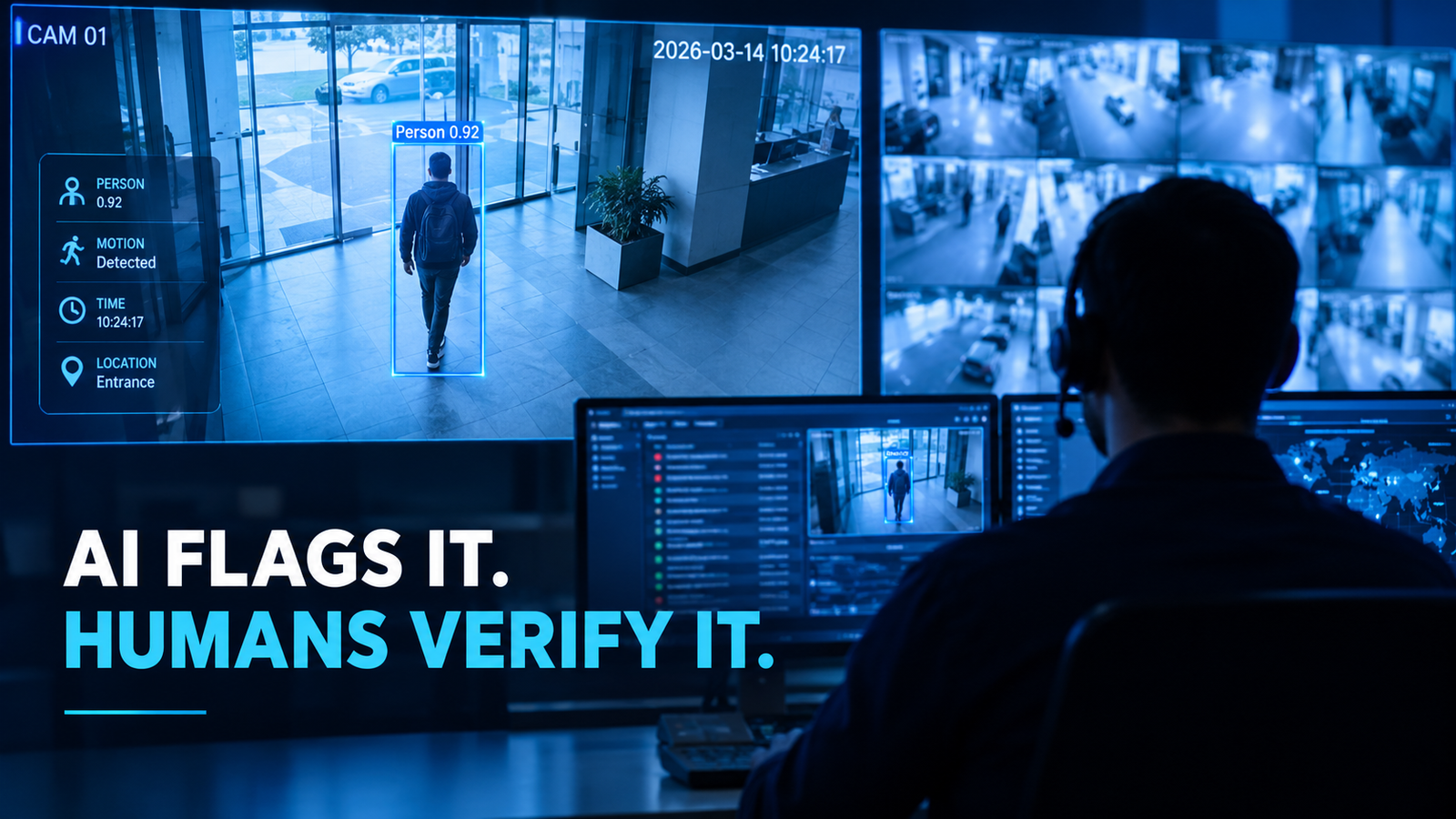
Smart cameras can spot motion, people, and unusual activity across dozens of feeds. But when a guest claims there was a hair in his dinner, or a facility needs to know whether procedures are being followed, someone still has to decide what the footage actually means. Here is how modern CCTV monitoring really works, with two real examples.
Published by Synthesis BPO · Reviewed by Vinesh Nair, Co-Founder, VisionSync Solutions · October 22, 2026 · 9-minute read
Key facts
- Cameras have gotten smarter. AI-enabled cameras can flag motion, people, and unusual activity, so one operator can cover more feeds than before. An alert is still not a verdict.
- Most alarms are false. Police and security-industry figures put false intrusion alarms at roughly 94% to 99% of activations, which is why some police departments only dispatch when an alarm has been verified.
- The model that works is hybrid. AI filters the noise. Trained people verify what happened, document it, and escalate along a procedure the client has approved.
- Speed matters. In one restaurant dispute, we had about 30 minutes and had findings back to the owner in about 15.
- Typical cost: $7 to $10 per person per hour for CCTV monitoring, quoted per person rather than per camera and customized to the site.
- Planning estimate: one operator may monitor around 7 to 8 motion-enabled feeds, or 3 to 5 static feeds, depending on the actual setup.
- Where our operators are: monitoring staff may be based in India or the Philippines. We disclose this and agree it with you before camera access is granted.
What is CCTV monitoring in 2026?
CCTV monitoring means having trained people actively watch, review, and respond to what your cameras capture, live or from recordings, instead of only storing footage in case you need it later. A camera records. Monitoring adds attention, judgment, and a defined response.
It has changed a lot in a short time:
| Era | How it worked | The weak spot |
| Record-only | Footage stored and reviewed after something went wrong | You find out too late |
| Live human monitoring | People watch feeds in real time | One person cannot watch dozens of screens all day |
| Motion alerts | Cameras ping whenever something moves | Shadows, animals, and weather flood operators with false alerts |
| AI analytics plus human verification | AI filters for people, vehicles, or specific behaviors; a person confirms what it means and escalates | Needs a clear procedure and trained operators |
Today’s AI-enabled cameras can flag the kinds of things that matter to a business: intrusion, theft, hygiene lapses, and negligence. That has changed how many people it takes to watch a facility. It has not changed who has to decide what an event means.
Do AI cameras make human monitoring unnecessary?
No. AI reduces how much footage a person has to watch, but it does not replace the person who decides what an event means and what should happen next.
AI is good at answering “did something move?” It is much weaker at “does it matter?” Is that figure an employee or an intruder? A delivery driver or a trespasser? An accident or something deliberate? Those calls depend on context, and the cost of getting them wrong is real: a needless police dispatch, a missed theft, or a false accusation.
Here is a practical way to divide the work:
| What AI does well | What a trained operator adds |
| Filters out shadows, animals, and weather | Judges what an event actually means in context |
| Flags people, vehicles, or after-hours movement | Confirms or dismisses the alert by looking at the footage |
| Lets one operator cover more feeds | Follows the client-approved escalation steps |
| Never gets tired | Documents what was seen, and knows when to say “unclear” |
The efficiency gain is real. On our own planning estimates, an operator can cover roughly 7 to 8 motion-enabled feeds compared with 3 to 5 static ones. But that mostly changes what the person does: less staring, more deciding.
Why does verification matter? The false alarm problem
Because the vast majority of alarms are not real incidents, and acting on them without checking is expensive.
- Reporting in the security industry has cited U.S. Department of Justice figures putting false alarms at about 94% to 98% of the alarm activations police respond to. A city police FAQ in Georgia, published in 2021, describes more than 99% of intrusion alarm activations nationwide as false.
- In Fontana, California, police responded to 8,529 burglar alarms between July 2005 and June 2006. About 99% were false, the response cost roughly $255,000 in officer time, and the alarms led to one arrest. The department moved to a policy requiring alarms to be verified, by audio, video, a private guard, or an eyewitness, before officers were dispatched.
Verification is the idea behind that policy: before anyone acts, a person confirms that something real is happening. Camera monitoring with trained operators is one way of doing that.
Deterrence is the other half. A 2012 University of North Carolina at Charlotte study interviewed 422 incarcerated burglars. Nearly 60% said they would consider cameras or other surveillance equipment when choosing a target, and more than 40% said it would push them toward a different target. About 63% said they considered whether security personnel or police would respond if an alarm went off. In other words, a camera nobody is watching deters less than one that is clearly being watched and acted on. The study was funded by an alarm-industry research foundation, which is worth keeping in mind.
Case 1: The hair in the dish
A restaurant whose cameras we monitor day and night called us in the middle of a dispute. A guest had told staff he found hair and other particles in his food, said he would not pay, and threatened to sue. With the dining room in uproar, the owner needed answers fast. We had about 30 minutes, and the owner wanted to know one thing: what do the cameras actually show?
We reviewed the footage straight away and had our findings back to the owner in about 15 minutes. The footage showed that the guest himself had placed the hair in the dish after it was served fresh from the kitchen. We shared a still image and a clear account of what the cameras captured. What happened next was the owner’s decision, as it always is, and we were not told how it was resolved.
Three things stand out:
- It did not need AI. The cameras in that restaurant had no AI features. A trained person looking at the right footage, quickly, made the difference.
- Speed was the point. About 15 minutes from the call to findings, while the dispute was still live, not days later.
- Reporting beats accusing. Our operators describe what is visible. The business decides what to do with it. We do not make accusations or legal determinations.
Any business with guests or customers on camera should also check notice and signage requirements with its own legal adviser.
Case 2: Calyx Peak, 20+ cameras at one Las Vegas facility
Calyx Peak is a Las Vegas-based cannabis cultivation and production company.
We monitor more than 20 cameras at its Las Vegas facility, with four operators covering business hours. The work covers hygiene, theft, the orderly handling of product, and whether staff are reporting on time and following the right procedures. The engagement is billed at $8.50 per person per hour.
Cannabis facilities are a useful example because the equipment rules are already strict. In Nevada, the state’s cannabis security rules call for cameras able to identify activity in low light around the clock, and the administrative code has set a retention requirement of at least 30 calendar days for stored recordings. (Rules change, so confirm the current text with your compliance adviser.) But a camera that records is not the same as a person who notices. Someone still has to see that a procedure was skipped, that something is out of place, or that product is not being handled the way it should.
Calyx Peak is one of our longest-running monitoring clients. It has reviewed our work on Clutch, and its owner, Howard Keum, regularly introduces us to friends and colleagues in the industry.
As with every engagement, the client defines what is watched and what our operators are allowed to do.
How hybrid monitoring works: what happens when something is flagged
Whether the first flag comes from an AI alert, a motion alert, or an operator’s own eyes, the sequence is the same:
- An event is flagged. It might be an AI alert, a motion alert, or something the operator notices.
- The operator checks the footage. Is it a person, a shadow, an employee, a delivery?
- The operator follows your approved escalation steps. That can mean documenting what is visible, notifying your designated contact or on-site guard, and, only if you have authorized it, activating an alarm or intercom. Calling a security number or 911 happens only when your written procedure expressly says so.
- If it is unclear, the operator does not guess. They record what they can see and work down your backup-contact list if the primary contact does not answer.
- There is a record. What was observed is documented, so you are not relying on memory.
What our operators do not do: intervene physically, act as emergency responders, give legal or medical advice, or guarantee that every incident will be detected or prevented. Physical response stays with on-site security or the appropriate responders.
Do you need CCTV monitoring? A checklist for 2026
- What are you trying to catch? Theft, intrusion, hygiene or safety lapses, procedure compliance, or disputes. Different goals need different coverage.
- Live monitoring, footage review, or both? Live monitoring watches events as they happen. Video verification reviews recorded footage after an incident, as in the restaurant case.
- When do you need coverage? Business hours, after-hours, weekends, or 24/7.
- What does your camera setup look like? Number and type of cameras, and whether they have motion or AI alerts. This drives how many people the work needs.
- Who decides what, and who gets called? Define the events to watch for, the escalation steps, and the backup contacts before monitoring begins.
- Who has access, and where are the operators? You set camera views and permissions. Ask any provider where its operators sit. Ours may be in India or the Philippines, and we agree that with you first.
- What are the privacy and notice rules? You are responsible for notice, consent, and privacy requirements, so confirm them with your legal adviser.
- How will footage be handled? Agree access, transfer, retention, and deletion up front.
Explore the service pages: Camera Monitoring, Remote Monitoring, Workplace Monitoring, After-Hours Monitoring, and Video Verification Monitoring.
What does CCTV monitoring cost?
CCTV monitoring typically runs $7 to $10 per person per hour. The rate covers the operator’s compensation and benefits, delivery infrastructure, and operating overhead, and it is quoted per person, not per camera. Your final rate depends on your coverage schedule, site, number and type of cameras, staffing, and how complex your procedure is, so it can come in lower or higher. For example, our Calyx Peak engagement (four operators covering business hours at its Las Vegas facility) is billed at $8.50 per person per hour. See the CCTV monitoring pricing page for the breakdown by monitoring model.
Why Synthesis BPO and VisionSync Solutions
Synthesis BPO is a sister concern of U.S.-registered VisionSync Solutions LLC, our parent company. Camera monitoring is built on the same principles we apply across our services:
- A procedure you approve before work starts. We build a site-specific SOP with you. You define the camera views, permissions, events to watch for, and what operators may do.
- An extended team, not a black box. You get regular reporting and calibration, so you can see what is being observed and how it is handled.
- Transparency about who and where. Delivery locations and access arrangements are disclosed and agreed before camera access is granted.
- Access limited to the agreed purpose. Camera access and footage are not shared with unrelated third parties.
- Clear, per-person pricing. No surprise line items added later.
This article describes our human monitoring service. It does not represent Synthesis BPO as selling cameras or AI analytics software.
Request a custom proposal: call +1 (800) 427-4470 or email info@synthesisbpo.com.
Frequently asked questions
What is CCTV monitoring? Having trained people actively watch, review, and respond to what your cameras capture, live or from recordings, rather than only storing footage for later.
Do AI cameras replace human monitors? No. AI can filter noise and flag events, which lets one operator cover more feeds, but a person still has to judge what an event means and follow the escalation steps you approved.
What is video verification monitoring? Mainly, reviewing recorded footage after an incident to locate and document what happened, going back as far as the recordings remain available. Live-session verification is also possible and is scoped separately.
Can monitoring settle a dispute like a customer complaint? It can help locate and document what the cameras captured, as in the restaurant case above. What the footage means legally, and what to do about it, is for you and your advisers to decide.
How much does CCTV monitoring cost? Typically $7 to $10 per person per hour, customized to your site and requirements.
Can an operator call the police or 911? Only if you have expressly authorized it and written the circumstances, number, and instructions into your SOP.
Where are your monitoring staff located? They may be based in India or the Philippines, depending on the engagement. This is disclosed and agreed with you before camera access is provided.
Do I need new cameras? We work from the camera views you authorize. Which systems and access methods fit is confirmed during scoping.
Does monitoring guarantee every incident will be caught or prevented? No. Monitoring helps identify and report events visible in the available camera views, but no service can guarantee every incident is detected or prevented.