The Virtual Assistant Has Changed: How Business VA Support Works in 2026
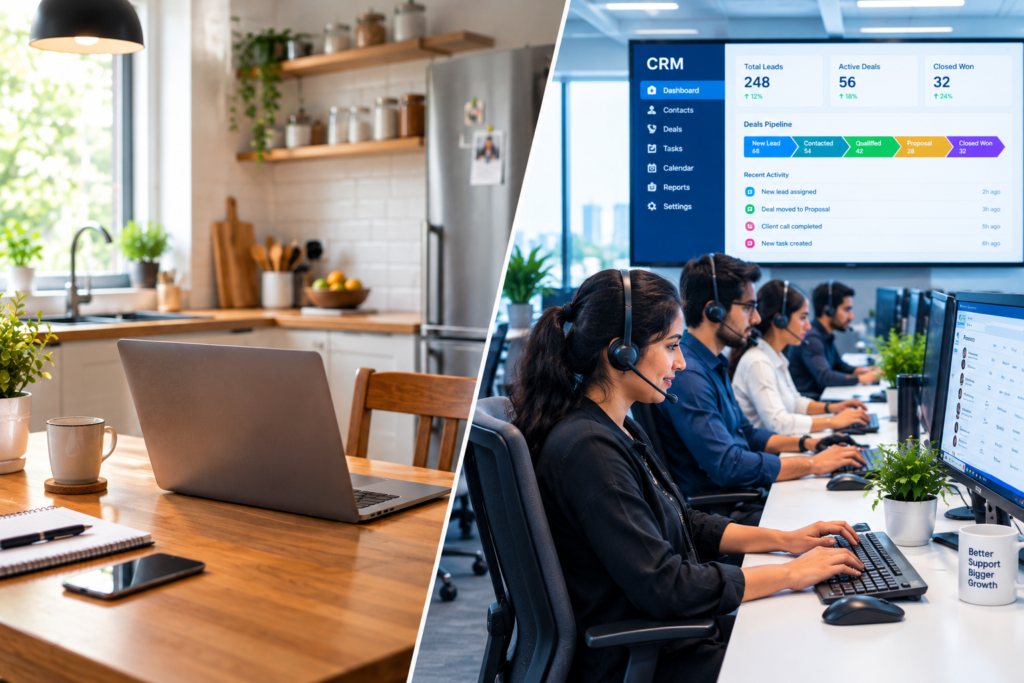
A virtual assistant used to mean one freelancer working through a to-do list from a home office. Today, the best business VA support looks a lot more like adding a trained, supervised member to your team, one who answers your calls, keeps your CRM current, follows up with customers, and works with AI tools instead of against them. Here is what changed and how we run it. Published by Synthesis BPO · Reviewed by Sumeet W, Co-Founder, VisionSync Solutions · October 24, 2026 · 9-minute read Key facts What is a business virtual assistant in 2026? A business virtual assistant is a dedicated remote team member who handles ongoing business tasks on your behalf: answering calls and emails, keeping CRM records current, scheduling, following up with prospects or patients, and researching. The role sits closer to your front office than to a one-off task list. It overlaps with a personal VA. The difference is mostly context: a business VA typically supports a company, department, or senior leader, with more seniority, scope, and process around the work. How has virtual assistant support changed? It has moved from task-by-task help to accountable, supervised team membership. Here is the difference between the typical freelance or marketplace model and the dedicated model we run: Typical freelance or marketplace VA Dedicated, supervised VA Where they work Usually from home, often alone A company office, with a team around them Training Mostly self-directed You train the first batch; our trainers sit in and document the process Supervision The client manages every detail A supervisor, team leaders, and managers oversee the work If it isn’t working Start the search over We replace the person, typically within one to two weeks Records Depends on the individual Calls, notes, and follow-ups are logged in your CRM AI Individual choice, often undisclosed Used where it helps, and with your approval Coverage One person, whenever available Planned shifts, with a roster for extended hours This describes common patterns, not every freelancer. Many are excellent. The point is what changes when a VA is part of a managed operation. Shift 1: From freelancer to team member A VA who only receives tasks has to be told everything. A VA who is trained on your business can run a function. That is why we ask clients to train the first batch themselves, usually a day or two, and to stay available for questions during the first week or two. Our trainers sit in, document your process, and build it into the account, so that retraining a replacement, or adding a second VA, does not mean reteaching everything. A supervisor oversees the work, reports on it, and calibrates with you regularly: typically weekly at the start, then once or twice a month. We think of the supervisor as the captain of the ship. Shift 2: From inbox helper to the front line of your business Business VAs increasingly do the work customers actually see. They answer the phone, record who called and why, send confirmations, and follow up. Two examples, both anonymized because neither client has given us written permission to share its name: We are not claiming measured business outcomes, such as revenue or booking rates, for either example. What both show is the shape of the role: the VA owns a recurring function, inside your systems, with a clear boundary around what they can decide. You define that boundary. When something needs your approval, the VA tells the caller that a response will follow and comes back within the time you set. A VA also does not give medical advice or make decisions that belong to your clinicians or your team. How does 100% call coverage work? Our standard on answering-support programs for dental clinics is 100% coverage of the calls received: each call is either answered within the agreed number of rings or returned with a callback. How we hold it depends on the size of the team on shift: The commitment is that no caller is left without a response. It is a coverage standard, not a promise that no caller ever waits a few minutes for a callback. Shift 3: AI-assisted, human-accountable AI has changed what a VA does all day, mostly by taking over the record-keeping. Many of the CRMs our clients use now have AI built in, so much of the information from calls and messages is captured automatically. The VA still takes notes and sends emails, and email drafts come from our in-house trained AI model, or from a third-party or open-source AI platform when the client approves it. The tools differ by account, and the choice is yours. Why this matters: Gallup found that 45% of U.S. employees used AI at work at least a few times a year in Q3 2025, but only about 10% used it daily, and just 37% said their employer had implemented AI to improve productivity or quality. In other words, AI is present in most workplaces but built into very few jobs. A VA whose daily workflow already includes AI-assisted record-keeping and drafting is one way to close that gap without your team having to learn new tools. The rule we hold to is that AI does the heavy lifting on records and drafts, and the VA stays accountable for what goes out. Our VAs are trained thoroughly on the AI tools used on each project, so they can use them to support your prospects and clients the right way. Nothing runs on autopilot: the AI is managed and moderated by the VA according to what each request needs. AI does not know your clinic’s practices or your sales process. Training does. We also never add AI to an engagement you have not approved. Why where the VA sits matters: remote does not have to mean unsupervised Remote work is now normal. Gallup’s 2025 data shows that only about one in five remote-capable U.S. employees is fully on-site. Your VA working somewhere else is unremarkable. What matters is