Choosing a Tech Support Partner in 2026: What to Outsource, What to Keep, and How AI Fits
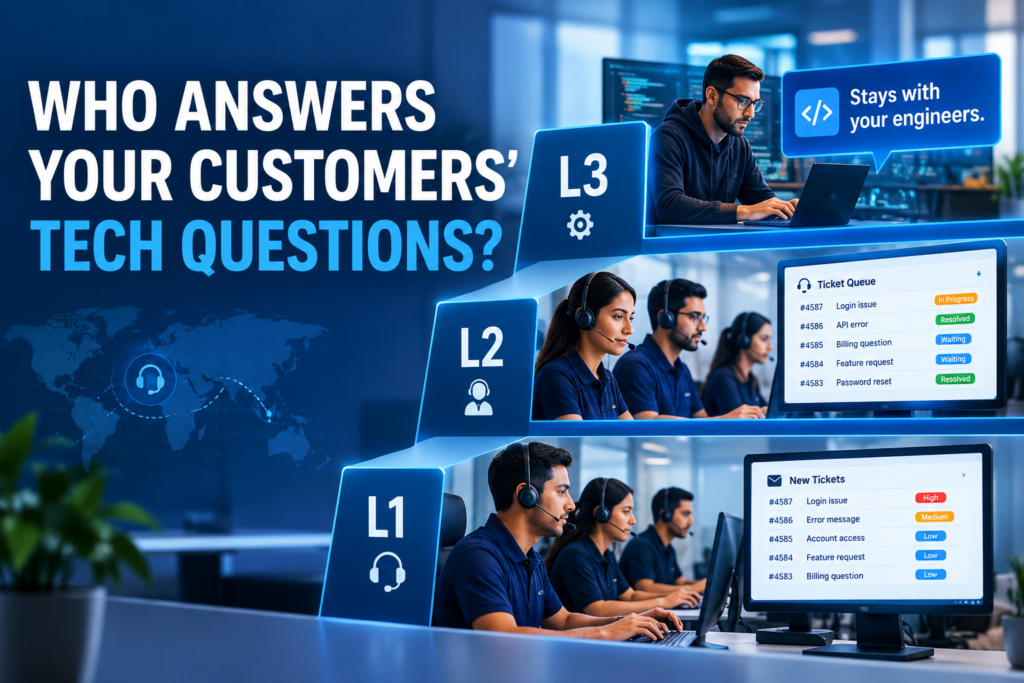
Most businesses that sell a product or a service end up answering the same technical questions all day: how do I set this up, why can’t I log in, how do I use this feature. That is exactly the work an outsourced support team can take over. Here is how to tell what to outsource and what to keep, how AI belongs in the picture in 2026, and what to ask before you sign with anyone. Published by Synthesis BPO · Reviewed by Lary Wilcox, Strategic Advisor, VisionSync Solutions · October 309, 2026 · 10-minute read Key facts What is a tech support partner? A tech support partner is a team outside your company that handles technical questions from your customers or staff, following your procedures, using your ticketing system, and escalating what it cannot solve. The work is mostly practical: how to set something up, how to get in, how to use a feature. This is easy to confuse with managed IT services, which cover a different job: monitoring servers, maintaining networks, managing backups, and running security tools. A managed IT provider keeps your systems running. A tech support partner talks to the people using your products and systems and gets them unstuck. Many businesses need one or the other, and some need both. Be clear about which you are shopping for before you compare vendors. What do L1, L2, and L3 support mean? Support is organized in levels (also called tiers) so each issue is handled by someone with the right skill, and the hardest work is not tied up with the simplest. These are common definitions, and companies set their own boundaries: Level Typical work Who does it Do we deliver it? L1 Password resets, software installation and downloads, basic setup, “how do I” walkthroughs, logging and routing tickets Sound technical associates who have worked in L1 support for some time, or have been trained thoroughly for it Yes L2 More involved issues: access and permission problems, account issues on platforms such as Microsoft 365, Google Workspace, AWS, and Azure, server or cloud tickets within the scope you define, configuration walkthroughs The same associates developed to a deeper level, or experienced technical staff Yes, often as a blend of L1 and L2 L3 The most complex problems, where a technically skilled person on the other side needs expert help; deep cloud or system work; sometimes an on-site visit Specialist engineers, often the product’s own team Not at present L1 and L2 are not tech specialists solving exotic problems. They are people who know your product well, follow a documented process, and know when to escalate. Why do most businesses outsource L1 and L2 but keep L3? Because of volume and complexity. People buy a product or service and then do not know how to set up their password, get access, or use the platform. Those questions arrive every day, they follow patterns, and they take the most time. That is L1 and L2 work, and it is well suited to a trained team following your instructions. L3 is different. It is complex, it does not come up daily, and it sometimes needs a visit to the customer. Most businesses prefer to keep that in-house so their own engineers stay close to the hardest problems. In our experience, L3 and above is rarely outsourced, so we focus on L1 and L2. A good partner will tell you plainly where its scope ends. If a provider claims to do everything at every level for any product, ask to see who does it. How is AI changing tech support in 2026? AI now answers a growing share of the first questions, and the businesses that do this well keep a person within reach. Chat and email contain many repeated questions, and AI can answer a large share of them once it has been given your answers. Customers are not asking for one or the other. Gartner research reported in August 2026 found that 87% of customers say it is essential for companies to offer an option to reach a human agent when they use generative AI, and it advises service leaders not to make AI a mandatory first step for every issue. It also found that customers were about three times more likely to use third-party tools such as ChatGPT than a company’s own chatbot in their latest service interaction. Here is how we approach it: This is a way of working, not a guarantee of how much an AI will resolve. It depends on your product, your documentation, and what you approve. The reason to do it this way is that AI handles the repetitive volume without needing a person on every question, and people handle everything that needs judgment. Which channels and tools should a partner support? Phone, chat, and email, tracked through a ticketing system, so nothing is lost between channels. Ask any provider which of your tools it already works in, and who trains the team on them. Case study: omnichannel L1 and L2 support for a Dallas retailer A Dallas-based eCommerce retailer selling home improvement, decoration, and home security products across the U.S. relies on us for technical support. Its customers ask the kind of questions you would expect from products people install themselves: setup, installation, and how to use what they bought. That puts the account at L1 and L2. It is an omnichannel arrangement. Customers who want to talk it through call. Customers who would rather type use chat or email. The same technically trained team handles all three. One dedicated team member covers the account during Dallas business hours. Outside those hours, a voice menu captures the caller’s information, and the team member follows up the next business day. The relationship has run for more than a year, at $15 an hour. We are not publishing a resolution rate or customer score for this account, because we have not been given permission to share one. The example shows the shape of